The double murder of Akhtar Afindi and Jamshed Alam at their Shaheen Park residence recently, has thrown up interesting facts like, it had a gay angle. According to cops, Akhtar was a bisexual and in relationship with Jamshed. It reminds one of the sensational Pushkin Chandra double murder case.
Pushkin Chandra, a USAID employee, and his friend Kuldeep were murdered in former’s posh Anand Lok residence in August 2004 by gay prostitutes. These murders are just the tip of the iceberg. The business of gay prostitutes and gigolos is thriving in Delhi’s underbelly. Unable to make it big in the glam world, some struggling models and college hunks are lured by sex with different women and earning quick money to make their lives easy. Some unemployed youth, generally having weak economical background, become gay prostitutes.
A gigolo’s tale
It was in 1991 that a young 18-year-old Suresh came from Dehradun, nurturing his dreams of becoming a footballer and donning Indian colours. However, his tale wasn’t of success and glory, it had other ingredients to it, full with spice and sexual flavours.
Struggling to make a career in football, Suresh was introduced to male prostitution by a colony aunt. She was fascinated by the sporty physique of Suresh and for sexual favours she started giving her money. Soon he was introduced to few more ladies who were ready to pay for sexual favours. He left football and became a professional prostitute or a gigolo often meandering around Ring Road at South Extension or Andrewsganj. Three years of joyride, Suresh was finally diagnosed of veneral disease. All that boasting about sleeping with different women and money splashing at home in Dehradun became his nemesis.
Gigolo factoid
Gigolos then remained inside the closet. However, as Delhi entered a new millennium, things changed. Gigolos became widespread here; perhaps the booming Indian economy has also a share in their growth. They come in all forms – masseurs, escorts, male strippers and male prostitutes. Few who don’t fit in that bracket have managed to become gay prostitutes earning just Rs 200-300 per hour. A search in google for ‘gigolos in Delhi’ returns 644 web pages mostly having phone numbers and contact details of them. And never do they land up in the hands of the law. It’s a business where these male and gay prostitutes roam around doing their business scot-free.
“It’s a profession where one enters by choice and has the elements of everything that today’s youth dreams of. Unlimited sex with different partners in cooler climes of five top hotels, dining and partying in top nightclubs and meeting the likes of rich and famous of the city, not to mention about maintaining hefty bank balances and driving flashy cars,” says a Delhi-based gigolo.
Hardships too lead to it
Bollywood hero Vikram Kumar who played a character in the movie Sauten where he has an affair with both, daughter and stepmother simultaneously says, “Becoming a gigolo is quick money for aspiring actors and models with smart looks and nice body, only thing is they have to sleep with ugly looking aunty.” Vikram, who spent quite a time in Delhi before shifting his base to Mumbai, says, “It mostly happens in Mehrauli and chattarpur areas in farm houses. These good-looking guys go to parties organised by rich ladies and do a strip show and so on.”
In Mumbai too Vikram says, “Most of the budding models in search for a career in Bollywood hang out in innumerous coffee joints so that someone from the industry might notice them and give a break. Since Mumbai is an expensive city, they need money to survive. Till the time they get support from parents it is ok. But then they start indulging into such activities to sustain a living. In Mumbai there are some coordinators who facilitate them in getting business. So daytime, it’s coffee joints for them and night they do business sleeping around with aunties.”
Male prostitution in Delhi, Vikram says, is not that organised. “Lot of such things happen at the ramp shows. Sadly, male models get ruined by designers, as some have to sleep with them too, not to talk about women,” he adds.
As of now, business for gigolos, gay prostitutes and male escorts is rocking. With the gleaning eye of cops closed, welcome to Delhi - the world full of sex, sleaze and disease.
Monday, May 15, 2006
Male for Sale


Saturday, May 06, 2006
The Coke stops here!
Finally Judiciary has opened its eyes and the Supreme Court has frowned upon the "liquor addiction" among "younger generation". Not only this, the Court has also asked the government to work towards reducing the consumption of liquor. It's a welcome step but it seems that the Court should also turn its eyes towards the growing number of drugs in the capital and in the country as a whole.
Delhi is fast becoming the Drug capital of India and it is making its presence felt in the international drug market too as an important transit point. The Indian capital ignonimously sees a heavy import of Cocaine and ecstasy pills in the country whereas it is becoming a huge exporter of heroin, which comes to the capital from Madhya Pradesh, Rajasthan and Uttar Pradesh and hashish, which comes to the market from Malana, in Himachal, Nepal, Arunachal Pradesh and Manipur.
The hash from Nepal and Arunachal is fast catching up in the Indian as well as international market and is competing with the famed Malana cream. Also drugs from Afghanistan have managed to sneak into India through some Kashmiri youth also dealing in illegal arms supplies was busted by Delhi Police's Narcotics department last year in November. It was claimed to be the biggest catch of the decade, sadly the dealers are out on bail and not even a single drug dealer caught by the cops last year is languishing in jail. This is where the judiciary now has to turn its eyes.
Coke trails
In recent times, Cocaine and other synthetic drugs have already gripped the youth and P3 frat in the city. Cocaine generally comes to India from Africa. India is an important transit point for this white gold. The normal international trade route of cocaine is from Columbia to African countries from where it travels to either Delhi or Mumbai and from here it travels to European countries. A large part of the consignment is dropped in India for consumption. It costs Rs 3,500-8,000 per gram in the Indian market.
Heroine
It is nothing but raw opium treated with acetic anhydride. Acetic Anhydride is although banned in the country but is used in the dye industry. According to AS Cheema, DCP (Narcotics), "It is sold in the market for Rs 3 lakh per kilogram, but to get a hit very low quantity is required. For a drug addict, heroine worth Rs 40 or 50 is enough to get a high."
That's the reason it is widespread in Delhi. According to Cheema, "Heroine is an injectible drug. The heroine addicts exchange needles and it can have serious repercussions like communicable diseases.
The importance of heroine in terms of cocaine dealers is that it used for reverse trade. "Carriers of cocaine take back heroine to Nigeria and other African countries as well as European nations," says Cheema. Heroine is exported from the country through export consignments. They are generally packed inside shoes and last year a consignment was caught where drugs were hidden inside shock absorbers. Generally Department of Revenue Intelligence and Customs catch these rackets.
Hashish
It is Hash or hashish and grass (dried cannabis leaves), which is a cause of worry for narcotics officials. Intake of this is extremely widespread among the youth and student community. "A large quantity of hash is being consumed in Delhi. Recently we caught a 50-year-old woman with 9 kg of hash imported from Nepal. Sad part is that large part of students are getting caught in this cobweb," says Cheema.
Hash and grass is freely available in Delhi and can easily be obtained from jhuggi clusters mostly surrounding campuses and most of south Delhi areas. Denotified tribes and small drug peddlers mostly sell these drugs. "It's very difficult to curtail them. It's a family-based drug business. If even two or three of the family are in jail, the business never stops. Be it wife or daughter or son, everybody is involved in this selling business," adds Cheema.
On the parallel, Delhi is also one of the biggest exporters of hash. The famed Malana hash is exported from here. Local people from Kullu valley, Israelis and Nigerians are involved in the exporting business. A kilogram of hash from Malana costs Rs 3 lakh in Delhi. When it reaches the international market, it costs a cool Rs 10-12 lakh.
Friday, April 21, 2006
Nepal and JNU
Believe it or not, the seeds of the joint agreement between seven Nepali political parties and Maoists were sown in Capital’s Jawahar Lal Nehru University. Rajan Bhattarai, foreign department secretary of Communist Party of Nepal (Unified Marxist-Leninist) (CPN-UML), says, “After the February 1 incidents (when King Gyanendra dissolved coalition government and assumed power), my party sent me to India. It is here when we got in touch with Maoist leaders and had a joint understanding with them. JNU is the place where the seed of this pact was planted.”
However, Bhattarai refused to divulge the details about the meetings between seven political parties and Maoists. Bhattarai came to India as a representative of his party to lobby for restoration of the democracy in Nepal. He along with other political activists have been leading the agitation here in Delhi.
Alongside all these activities, Bhattarai is also utilising his time to do something productive. He has enrolled in PhD degree in International Studies in JNU. In fact Bhattarai is not the only one, some of his peers too are enrolled in Phd. “I was here in India for four-five months when I enrolled in the course. There are around 15-20 political leaders and activists enrolled in JNU,” he says.
Prominent among them are Deepak Bhatt (UML), Yogendra Shahi (UML), Human rights and Nepali Congress activist Dinesh Prasain, Nepali Congress activist and Terai leader Amresh Kumar Singh and Hari Roka. Apart from these the rest too have who are pursuing their PhD programmes have joined the agitation and help them in organizing protest marches, rallies, etc.
However, presently Amresh Kumar Singh is in jail as he was arrested there and Hari Roka has gone to Nepal too.
Dinesh Prasain of Nepali Congress feels at home in JNU. “After Feb one incidents, I was very active for two weeks in organising protests and keeping track of information flow. But cops were hounding me to arrest so I fled the country and came to JNU and enrolled in a PhD degree in political sociology.
Another student leader Deepak Bhatt too has enrolled in a PhD programme, but he got enrolled in 2003, before the Feb 1 incident and is in Delhi for several years now. JNU not only has been a hot seat of learning to these leaders but in the past too Maoist leader Dr Baburam Bhattarai completed his doctorate from here. Nepali Congress Democratic leader Pradip Giri also came here for further education.
Nepal is burning
Top revolutionary leader and second in command of banned outfit Communist Party of Nepal (Maoist), Dr Baburam Bhattarai has described King Gyanendra’s new year message as “an attempt to hoodwink the world opinion and perpetuate his unconstitutional and autocratic rule.” In an exclusive interview, the Maoist leader spoke at length about problems gripping Nepal and their struggle for getting Nepal rid from Monarchy.
Q: Do you think King Gyanendra’s declaration of holding elections in Nepal is a positive step towards restoration of democracy?
A: The real issue is transfer of sovereignty and state authority to the people through the election of a genuine Constituent Assembly. The talk of election to Parliament at this moment does not make any sense. So it is wrong and misleading on the part of certain media to see the King’s statement as a positive move. The King’s statement has been rejected by the CPN (Maoist) and the Seven Party Alliance. The people’s movement will continue until the monarchy is toppled and a democratic republic set up in the country.
Q: Indian Intelligence reports say that they are seriously working towards countering the growing nexus between Nepal Maoists and Indian Naxalites…
A: The reports of so-called nexus between the Maoists of India & Nepal are not only highly exaggerated but also mischievous and preposterous. Being proletarian internationalists by ideological persuasions, Communist revolutionaries of all countries, including India and Nepal, have ideological affinities to each other, but nothing more than that. It is highly irresponsible on the part of certain forces both in India and Nepal to spread such baseless romours and vitiate the political atmosphere in the midst of the decisive anti-monarchy democratic movement in Nepal.
Q. They also say that there was a hand of Nepali Maoists in the recent hijacking of train in Jharkhand and supplying of arms to Naxalites…
A: It is the concrete example of a motivated disinformation campaign on the part of certain pro-monarchy forces in India to scuttle the growing sympathy for the Nepalese democratic movement there. We challenge these forces to prove the veracity of such baseless allegations with concrete evidence.
Q. Aren’t you concerned about the situation of Nepal. Most of the areas in Western Nepal are facing an exodus of men. Because of the fear of Maoists, they are fleeing Nepal for India. (Perhaps, if you do a census of some districts in the apple belt of Himachal Pradesh, Nepalis will easily outdo the local Himachalis in terms of numbers.)
A: Yes, we are seriously concerned about the large-scale out-migration of the unemployed youths from the hills of Nepal. However, it is not because of the Maoist People’s War (PW), which started only ten years back, but because of ‘development of underdevelopment’ under the feudal monarchical rule for the past two and a half century. The millions of poor Nepalese seen in the streets of India doing sundry menial jobs or joining as mercenary soldiers in Indian and British armies have been forced to leave their hearth and homes because of lack of economic development in the country under a semi-feudal and semi-colonial set-up. Our revolutionary democratic movement currently spearheaded in the country is basically aimed at ending this pathetic situation and creating a democratic, peaceful and prosperous Nepal.
Q. Tourism, which contributes to Nepal’s economy in a big way, is affected by this war considerably. Don’t you think people of Nepal suffer from this movement?
A: Not only tourism but the entire economy is suffering for long. It is wrong to say that economic decline started after the Maoist PW. If you look at the growth trend of the economy for the last 40 or 50 years, it hovers around one or two per cent per annum. That is why we are fighting for a progressive restructuring of the society and economy by overthrowing the feudal monarchy.
Q. Do you think that King Gyanendra will be perturbed by these activities (like strikes, demonstrations, etc.) and you will achieve success?
A: If Nepal is to develop and prosper, the monarchy has to be abolished. The rising tide of people's movement seen for the past week is enough proof that the monarchy's days are numbered.
Thursday, March 23, 2006
Travel Tales

Pokhara is arguably the most beautiful valley in Nepal but its story is similar as that of Kashmir valley, gripped by terrorism, the only difference, tourists here are not on the target of Maoists. In fact the day we reached Pokhara, we were greeted by the news of the twin bomb blasts in the heart of the city that injured 18. It would have sent a chill down the spine of any tourist who would of reached Pokhara.
However, the scene outside was different. The lakeside was bustling with tourists, markets were open, travellers roaming around freely along the beautiful lakeside market, which quite resembles streets of Pushkar minus the crowd, feasting their eyes on the majestic view of the Annapurna ranges.
The local crowd too is hip and happening here. The chicks are beautiful and the image of the mountain girl wearing the traditional cholo, that’s so symbolical of Nepal, is missing in Pokhara. Most of the adolescents have spent their lives in Brunei, Hong Kong, London and it reflects by the way they dress and carry themselves.
Thanks to the British Gurkha settlement here. Most of the British Gurkha soldiers after serving in UK, Brunei and Hong Kong have settled here and since their earning is in pounds, so people have a lot of spending power and hence the bustle in city’s economy.
They know how to party and Pokhara in fact boasts of one of the best nightclubs in Nepal – Amsterdam and Paradiso where party never ends.
For regular tourists, the day begins at 4.30 am as they head towards Sarangkot. A small hamlet situated atop a hillock, Sarangkot offers the beautiful view of Annapurna ranges, especially the Fish Tail Mountain, being kissed by the rising sun. One can even trek down to the city from here, a walk of just about an hour.
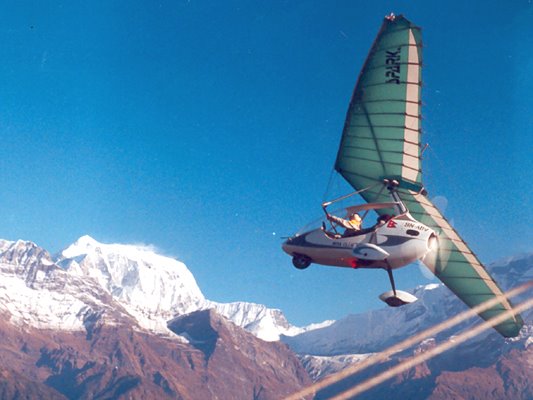
A must do here is take a flight in the Ultra light aircraft here. It offers spectacular view of the lakes, mountains and villages. This is an ideal way to see life from a new perspective. It’s a dream come true for those who wished they could fly like birds. Though it is lonely at the top, but the spectacular view from up high certainly makes it all worthwhile.
Another landmark in Pokhara is the International Mountain Museum, which is spread over an area of six hectares. The museum exhibits include information about the mountains, people and their culture, world mountain system, their geographic formation, flora and fauna. It also chronicles the development and past mountaineering activities in the Nepal Himalayas.
One can also visit the Peace Pagoda, Devi’s fall and several temples in Pokhara but without a boat ride in lake Phewa, your journey is incomplete. One can keep on boating endlessly around the lake, but for most of the tourists the temple located on an island in the middle of the lake is the centre of attraction.
Evening is full of activities in Nepal. One can hire a bike and pedal around the Pokhara city or visit nightclubs or restaurants located on the lakeside for a drink or two. Most of the hotels and restaurants organise cultural evenings with beautifully dressed Nepali lasses dancing to the folk songs. Resham firiri being the crowd’s favourite, a song that is every tourist’s delight and has been there ever since Tenzing Norgay and Sir Edmund Hillary conquered the Everest. A foreign trekker’s journey is considered incomplete in Nepal if he doesn’t learn and sing this song by heart.
